|
|
Veterans’ Association of the Chicago & North Western
Railway |
|
|
|
|
|||
|
Organized December 9, 1924 |
|||
|
|
|||
|
Marc
Deneen Remembers |
|||
|
|Home| |
|||
|
|
|
||
|
For Marc, working for the railroad for 43 years was a good experience. He came from a railroad family. His father, John, spent 30 years on the railroad, and Tim, his son, already has 30 years of service in as a locomotive engineer. "Yes, it was quite a change from telegraph and telephone
to computers, but I got familiar with them too. It wasn't a bad job. At the age of 61, I took my pension a year
early, in 1986. All I lost was 10
percent for one year. I get a fairly
good pension now," said Deneen, who lives in Riley where he grew up, a
small community 17 miles west of Deneen started with the Chicago & North Western on "I liked my job as long as the passenger trains were running. That was kind of exciting because you really had to be on the ball. It was a little bit strenuous. Some of the guys couldn't take it. There was pressure to keep the trains on time. Freight trains were put in the hole and they would be there until the passenger train went by. If you had some trouble, it was too bad." In 1958, the C&NW moved the Madison Division
dispatchers to Deneen, known for his story telling, tells about the day
Wagner left him in charge of the How has work changed? "Wagner used to tell me, ‘You have it good, because when I started working we worked 12 hours a day, seven days a week.’ When I started in 1943, I worked 48 hours; then they passed the 40-hour week. In those times, if you had to work your day off, it was time and a half." As have many others, the Deneen family has spent more than
a century in the railroad industry at a time when employment climbed from
1,040,000 in 1900 to 2,236,000 in 1920, then declined to 883,000 in 1960 and
227,000 in 2001. For much of the period of industrialization in the |
|||
|
|Home| |
|||
 Marc
Deneen (1925-2008) started with the telegraph key and ended on a computer
keyboard during his 43-year career with the Chicago & North Western
Railway.
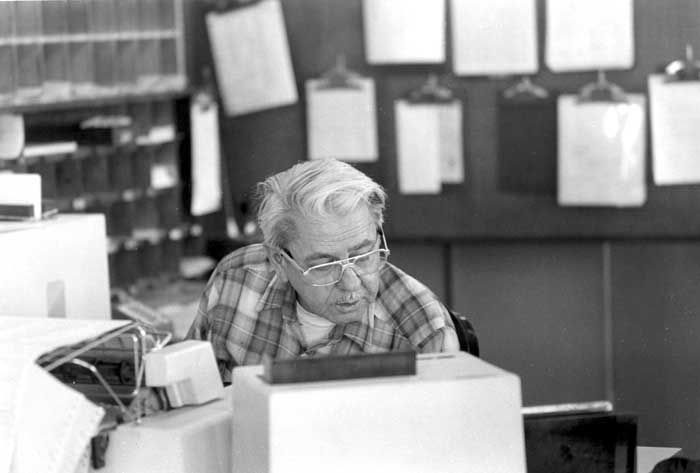
Marc
Deneen (1925-2008) started with the telegraph key and ended on a computer
keyboard during his 43-year career with the Chicago & North Western
Railway.
Posted: